Easy Bright Weave Crochet Plant Cozy Pattern

Some crochet projects are pretty. Others are practical. And every once in a while, you find a pattern that manages to be both.
This Bright Weave Crochet Plant Cozy is one of those projects.
Made with thick, chunky yarn and a wonderfully raised woven texture, this cozy is designed to slip around a plant pot and instantly give it a softer, more colorful handmade look. But the clever thing about this pattern is that it doesn’t have to hold a plant at all.
The original pattern specifically suggests using it as a catchall for items such as crochet hooks, which means the same project can become a yarn-room organizer, craft basket, desk container, or decorative storage piece. RHC0511-020343M
Designed by Tammy Hildebrand, the cozy uses Red Heart Vivid yarn in the vibrant Electric Blue color shown in the photograph on page 1. The thick yarn and oversized 11.5 mm crochet hook create a substantial texture without requiring dozens of rounds.
The finished cozy measures approximately 20 inches around and 9 inches tall, and the pattern is rated Easy. RHC0511-020343M RHC0511-020343M
What really makes this project stand out, though, is the stitch pattern.
Instead of ordinary double crochet stitches, the sides alternate groups of front post double crochet and back post double crochet. On the following round, those groups switch positions.
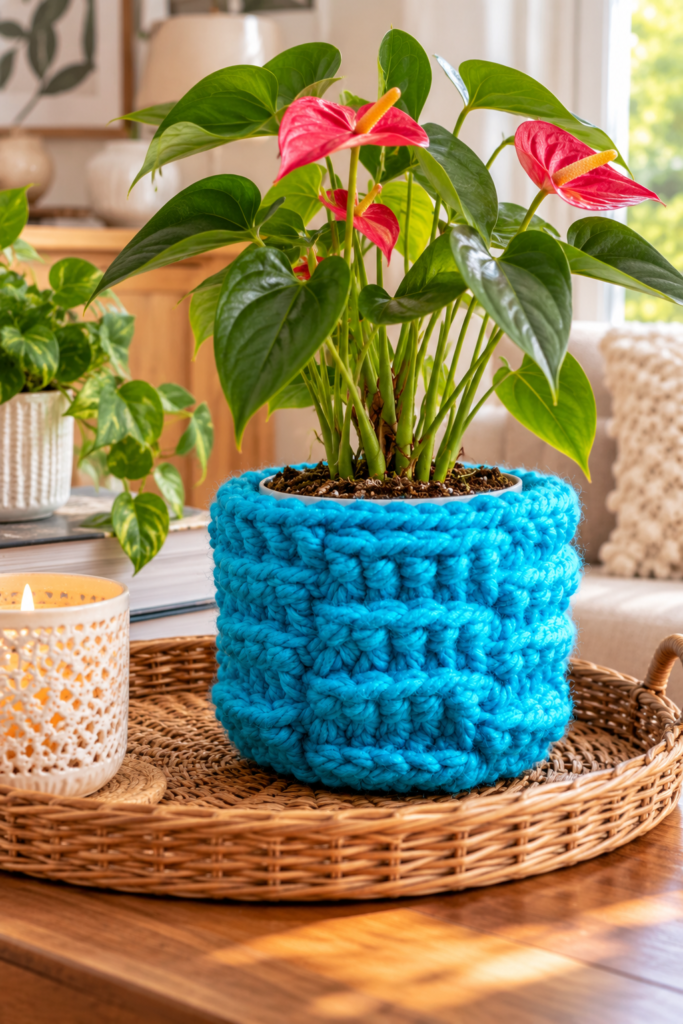
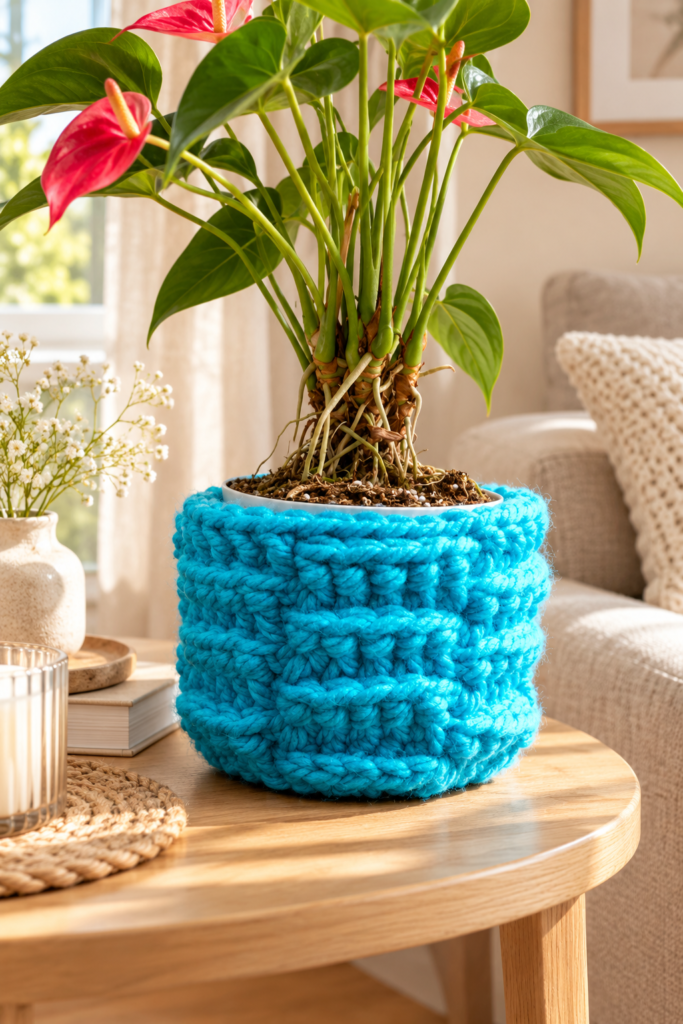
The result is the bold basket-weave texture visible in the page 1 photograph.
It looks complicated.
It isn’t.
Once you understand how front and back post stitches work, the main body is essentially just two rounds repeated three times.
Let’s turn the compact one-page pattern into a complete, easy-to-follow tutorial.
About the Bright Weave Plant Cozy
The Bright Weave Plant Cozy begins at the bottom and is worked upward in joined rounds.
You first crochet a small circular foundation.
The circle expands from:
10 single crochet stitches
to:
20 single crochet stitches
and then:
30 double crochet stitches.
Those 30 stitches become the foundation for the textured sides.
From Round 4 onward, you stop increasing.
Instead, you alternate groups of five front post and five back post double crochet stitches.
The pattern specifically tells you:
not to turn at the end of rounds.
That means you’ll keep the right side of the fabric facing you while building the basket-like texture. RHC0511-020343M
Pattern at a Glance
Project: Bright Weave Plant Cozy
Designer: Tammy Hildebrand
Skill Level: Easy
Finished Circumference: 20″ / 50.8 cm
Finished Height: 9″ / 22.9 cm
Yarn: Red Heart Vivid
Color: 6804 Electric Blue
Amount: 2 balls
Hook: 11.5 mm / U.S. P-16
Construction: Bottom-up in joined rounds
Main Texture: Alternating front post and back post double crochet
Total Rounds: 11
Finishing: Weave in ends
Why This Crochet Plant Cozy Is So Beautiful
The yarn color certainly makes an impact.
Electric Blue is vivid, cheerful and difficult to miss.
But even in a neutral yarn, this pattern would have plenty of character because the real feature is its texture.
The photograph on page 1 shows thick raised horizontal and vertical sections wrapping around the pot.
That woven appearance comes entirely from changing whether the hook passes around the front or back of a stitch post.
No separate strips are woven together.
No pieces are sewn across the finished cozy.
It’s all created directly through crochet.
That makes this a particularly satisfying project if you’ve been wanting to learn post stitches.
Materials You’ll Need
The original pattern requires:
Red Heart Vivid – 2 balls
in:
6804 Electric Blue.
You’ll also need:
11.5 mm / U.S. P-16 crochet hook
and:
a yarn needle. RHC0511-020343M RHC0511-020343M
Red Heart Vivid is listed in the pattern as available in:
5 oz / 141 g, 50 yd / 45 m solid-color balls
and:
4 oz / 113 g, 39 yd / 35 m balls for the other listed type. RHC0511-020343M
Because the source specifically uses two balls of Electric Blue, that is the quantity to follow when recreating the original project.
Crochet Gauge
The pattern gauge is:
6 post stitches and 5 rounds = 4″ / 10 cm.
The source instructs you to:
check your gauge
and change hook size if necessary to obtain it. RHC0511-020343M
Gauge is important for this project because the cozy is designed to reach a specific circumference.
If your stitches are much tighter, the finished piece could be noticeably smaller than 20 inches around.
If your stitches are much looser, it could become oversized.
Crochet Abbreviations
The source uses the following abbreviations:
Ch – Chain
Sc – Single crochet
St/Sts – Stitch/Stitches
FPdc – Front post double crochet
BPdc – Back post double crochet
Parentheses mean the directions inside them are worked into the same stitch.
An asterisk indicates a repeated section. RHC0511-020343M
The instructions also use:
Dc – Double crochet
and:
Sl st – Slip stitch.
Before You Start: Important Pattern Notes
There are three details from the original pattern that are especially important.
First:
The chain 2 at the beginning of the rounds does not count as a stitch unless otherwise stated.
Second:
When working your first post stitch, crochet around the:
chain 2 at the same time.
Third:
Do not turn at the end of the rounds. RHC0511-020343M
Keeping these instructions in mind will help your basket-weave texture remain consistent.
Understanding Front Post and Back Post Double Crochet
If you’ve never worked post stitches before, the terminology can sound much more intimidating than the actual technique.
Normally, when making a double crochet, you insert your hook through loops at the top of the stitch below.
Post stitches are different.
Instead of crocheting into those top loops, you work:
around the vertical body—or post—of the stitch.
That changes which direction the stitch projects from the fabric.
What Is Front Post Double Crochet?
For a front post double crochet, abbreviated:
FPdc
the hook travels around the stitch post in a way that pushes that post toward the front of your work.
The result is a raised ridge.
The basic movement is:
Yarn over.
Insert your hook from front to back and then back to front around the post of the stitch below.
Yarn over and pull up a loop.
Then complete the double crochet normally.
The stitch appears raised toward you.
What Is Back Post Double Crochet?
A back post double crochet, abbreviated:
BPdc
does the opposite.
The hook travels around the stitch post from the back side so the post recedes away from the front surface.
When groups of FPdc and BPdc are placed beside one another, the fabric develops obvious raised and recessed sections.
Then when those groups switch positions in the next round, the texture begins looking woven.
That’s the secret behind this entire design.
How to Crochet the Bright Weave Plant Cozy
Using Electric Blue:
Chain 4.
Join with:
a slip stitch into the first chain
to form a ring.
This tiny ring becomes the center of the cozy’s base.
Round 1 – Build the Center
This is marked as the:
Right Side.
Chain:
1.
Work:
10 sc into the ring.
Join with:
a slip stitch into the beginning sc.
You should have:
10 single crochet stitches.
Then:
Fasten off. RHC0511-020343M
The source explicitly says to fasten off after this first round.
Round 2 – Increase the Base
Chain:
1.
Work:
2 sc in the first stitch.
Then continue:
2 sc in every stitch around.
Join with a slip stitch into the beginning sc.
You should now have:
20 sc. RHC0511-020343M
Doubling every stitch allows the small circle to expand evenly.
Round 3 – Create the Double Crochet Foundation
Chain:
3.
For this round, the chain 3:
counts as a double crochet.
Work:
1 dc in the same stitch as the beginning chain 3.
Then:
1 dc in the next stitch.
Repeat around:
2 dc in next stitch
1 dc in next stitch
Join with:
a slip stitch into the top of the beginning chain 3.
You should have:
30 double crochet stitches. RHC0511-020343M
These 30 stitches are particularly important because the basket-weave pattern divides beautifully into groups of five.
Round 4 – Begin the Basket-Weave Texture
Chain:
2.
Remember:
This chain 2 does not count as a stitch.
Now work:
FPdc around the first stitch.
Continue with:
FPdc around the next 4 stitches.
You have now completed:
5 FPdc.
Next work:
BPdc around the next 5 stitches.
Repeat around:
5 FPdc
followed by:
5 BPdc.
Join with a slip stitch into the top of the first FPdc.
At the end of this round, you should have:
15 FPdc
and:
15 BPdc. RHC0511-020343M
This is your first textured round.
What Round 4 Is Doing
You have 30 stitches total.
Instead of treating them individually, imagine them divided into:
six groups of five.
Group 1 = Front Post
Group 2 = Back Post
Group 3 = Front Post
Group 4 = Back Post
Group 5 = Front Post
Group 6 = Back Post
Those alternating groups create the first half of the woven texture.
The next round reverses them.
Round 5 – Reverse the Post Stitches
Chain:
2.
Now work:
BPdc around the first stitch
and:
BPdc around the next 4 stitches.
That’s:
5 BPdc.
Next:
FPdc around the next 5 stitches.
Repeat around:
5 BPdc
followed by:
5 FPdc.
Join with a slip stitch into the top of the first BPdc. RHC0511-020343M
Notice what happened.
The section that projected forward in the previous round now recedes.
The recessed section now projects forward.
This switching action produces the woven effect.
Rounds 6–11
Now the pattern becomes wonderfully repetitive.
Repeat:
Rounds 4 and 5
three more times.
That means:
Round 6 = Repeat Round 4
Round 7 = Repeat Round 5
Round 8 = Repeat Round 4
Round 9 = Repeat Round 5
Round 10 = Repeat Round 4
Round 11 = Repeat Round 5
After finishing Round 11:
Fasten off. RHC0511-020343M
That’s the entire crochet construction.
Finishing the Plant Cozy
The finishing instructions are refreshingly simple.
Using your:
yarn needle
carefully:
weave in all yarn ends. RHC0511-020343M
There are no handles to attach.
No lining to sew.
No additional border.
No complicated assembly.
Once the ends are hidden, your Bright Weave Plant Cozy is finished.
Understanding the Basket-Weave Effect
The cleverest part of this pattern is how much visual texture comes from only two repeating rounds.
Imagine five stitches pushed toward you.
Beside them are five stitches pushed away from you.
That creates:
raised block → recessed block.
On the next round, their positions reverse.
As this sequence repeats vertically, those raised and recessed areas create the illusion of thick strips passing over and under one another.
That’s why the pattern is called:
Bright Weave.
Nothing is actually being woven.
The illusion is produced entirely through front and back post crochet stitches.
What the Finished Plant Cozy Looks Like
The photograph on page 1 shows the finished cozy wrapped around a plant container on a wooden surface.
The Electric Blue yarn is extremely vibrant, creating a dramatic contrast against the plant’s green leaves.
The yarn is also very thick.
That thickness exaggerates every front and back post stitch, making the woven texture visible even from a distance.
The upper edge remains simple rather than adding a decorative border, allowing the basket-weave stitch to remain the main feature.
At approximately nine inches tall, the cozy covers a substantial portion of the plant container.
Can I Use It Without a Plant?
Absolutely—and this idea comes directly from the original pattern.
The source specifically says that although the project is shown as:
a pot cozy
it can also work as:
a catchall for things like crochet hooks. RHC0511-020343M
That’s one reason this pattern is particularly useful.
If you make it and later decide you don’t like it around a particular plant, it doesn’t have to sit unused.
Turn it into storage instead.
Ideas for Using the Finished Cozy
You could use the original design as a plant-pot cover, which is exactly how it appears in the page 1 photograph.
Or follow the pattern’s suggestion and use it to hold crochet hooks.
Because the finished piece is essentially a chunky cylindrical container, it could also be adapted for lightweight craft-room organization.
Just remember that those additional uses are creative ideas rather than specific instructions supplied by the source.
Tips for Better Post Stitches
Don’t Work Into the Top Loops
The defining feature of FPdc and BPdc is that you’re crocheting:
around the stitch post.
If you accidentally work through the top loops, the woven texture will disappear.
Count in Groups of Five
Instead of thinking:
1, 2, 3, 4, 5, 6, 7, 8…
think:
five front, five back.
That makes the repeating structure much easier to remember.
Watch the First Post Stitch
The pattern specifically instructs you to work around the beginning:
chain 2 at the same time
when making the first post stitch.
Don’t overlook this note.
Don’t Turn
The source says:
Do not turn at the end of rounds.
Continue with the same side facing outward throughout the project.
Check Your Stitch Count After Round 3
You should have:
30 dc.
That’s important because the texture is based on six equal groups of five stitches.
Common Mistake: Forgetting to Reverse the Texture
Round 4 begins:
5 FPdc, 5 BPdc.
Round 5 begins:
5 BPdc, 5 FPdc.
That reversal is essential.
If you continue working front post stitches directly over front post stitches and back post over back post without switching as directed, you’ll create vertical ribbing rather than the intended alternating weave appearance.
So if your cozy doesn’t resemble the textured photograph on page 1, this is one of the first things to check.
Why the Oversized Hook Matters
The source specifies a:
11.5 mm / U.S. P-16 hook.
That’s much larger than the hook used for many ordinary crochet projects.
But this project also uses very thick yarn.
The large hook allows those chunky stitches to remain workable and creates the bold texture visible in the finished piece.
Using a dramatically smaller hook with the same yarn could make the fabric much stiffer and alter the finished circumference.
Frequently Asked Questions
Is the Bright Weave Plant Cozy beginner-friendly?
The original pattern rates the project:
Easy. RHC0511-020343M
It’s particularly suitable for someone who already knows basic crochet and wants to learn front and back post double crochet.
Who designed the pattern?
The Bright Weave Plant Cozy was designed by:
Tammy Hildebrand. RHC0511-020343M
What is the finished size?
The cozy measures approximately:
20″ / 50.8 cm in circumference
and:
9″ / 22.9 cm tall.
What yarn does the pattern use?
The source specifies:
Red Heart Vivid.
What color is the original?
The photographed version uses:
6804 Electric Blue.
How much yarn do I need?
The pattern calls for:
2 balls.
What crochet hook do I need?
Use:
11.5 mm / U.S. P-16.
You can change hook size if necessary to obtain gauge.
What is the gauge?
The source specifies:
6 post stitches and 5 rounds = 4″ / 10 cm.
How many stitches should I have after Round 1?
You should have:
10 sc.
How many stitches should I have after Round 2?
You should have:
20 sc.
How many stitches should I have after Round 3?
You should have:
30 dc.
How many rounds are in the cozy?
There are:
11 rounds.
Do I turn after each round?
No.
The original notes specifically say:
Do not turn at end of rounds.
Does chain 2 count as a stitch?
Not during the post-stitch rounds.
The pattern says the beginning chain 2:
does not count as a stitch unless otherwise stated.
What is FPdc?
FPdc means:
front post double crochet.
Instead of inserting your hook through the top loops, you crochet around the post of the stitch from the front.
What is BPdc?
BPdc means:
back post double crochet.
The hook is worked around the stitch post from the opposite direction, pushing the stitch toward the back of the fabric.
Why does the cozy look woven?
Groups of five FPdc and five BPdc alternate around one round.
On the next round, their positions are reversed.
Repeating those two rounds creates the raised basket-weave appearance.
Is there any sewing involved?
No assembly sewing is specified.
The finishing instruction is simply to use a yarn needle to:
weave in the ends.
Can I Make This Cozy in Another Color?
The source specifically calls for Electric Blue.
Choosing another color would be a creative modification rather than part of the original pattern.
Because the stitch texture is so strong, though, the design doesn’t depend entirely on the bright blue color for its visual interest.
If you’re recreating the PDF exactly, use Electric Blue.
Is This an Actual Plant Pot?
No.
This distinction is important.
The pattern creates a:
plant cozy.
The page 1 photograph shows the crocheted piece surrounding a separate plant container.
The source does not instruct you to place soil directly inside the crochet.
So when using it for a plant, think of it as a decorative outer cover rather than a replacement for the actual pot.
Why This Is a Great Project for Learning Post Stitches
Many post-stitch patterns can look intimidating because they combine cables, complicated stitch counts and multiple techniques.
This one keeps things much simpler.
You only need to remember two groups:
5 FPdc
and:
5 BPdc.
Then you reverse them.
That’s enough repetition to help you become comfortable locating the stitch posts and understanding how working around them changes the fabric.
And because the yarn is so thick, the stitches are large and visually obvious.
That can make it easier to see exactly what your hook is doing.
Final Thoughts
The Bright Weave Crochet Plant Cozy is a fantastic example of what can happen when a simple stitch repeat meets the right yarn.
The project starts with only:
4 chains.
Those chains become a small ring.
Ten single crochets create the center.
Twenty single crochets expand it.
Thirty double crochets establish the foundation.
Then the real transformation begins.
Five stitches come forward.
Five move backward.
Five come forward.
Five move backward.
On the next round, everything switches.
Repeat those two rounds three more times, and what started as a simple crochet cylinder develops the bold, chunky woven texture shown in the photograph on page 1.
There are no complicated color changes.
No separate pieces.
No lengthy assembly.
After Round 11, you fasten off, weave in the ends, and you’re finished.
The result measures approximately 20 inches around and nine inches tall—large enough to make a noticeable decorative statement around a plant pot while still being practical enough to repurpose as a catchall for crochet hooks or other lightweight craft supplies.
And because the original pattern is rated Easy, it’s an approachable way to move beyond ordinary single and double crochet and experiment with dimensional post stitches.
Make it in the original Electric Blue for the bold look shown in the pattern, place it around your favorite plant, and let that chunky basket-weave texture bring a little handmade color into the room.
Happy crocheting!