Caron Cotton Bloom Crochet Dishcloth
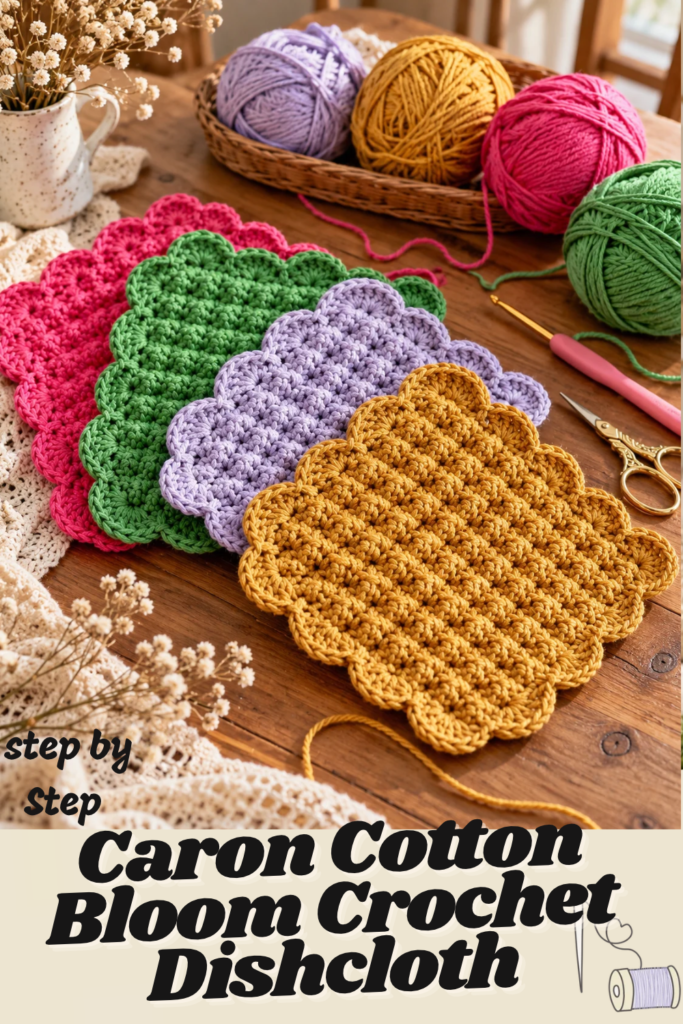
There is something wonderfully satisfying about crocheting something that is both beautiful and genuinely useful.
I love big crochet projects, but sometimes I don’t want to spend weeks working on a blanket or counting hundreds of stitches. Sometimes I want to sit down with a cup of coffee, choose a pretty ball of cotton yarn, and finish something before the day is over.
That is exactly why I love handmade crochet dishcloths.
This Cotton Bloom Crochet Dishcloth is small, colorful, textured, and surprisingly simple to make. The body uses a clever combination of single crochet and treble crochet to create a raised, almost bobbled surface without requiring a complicated stitch pattern.
Then, just when the square seems finished, we add a sweet scalloped crochet border that gives the dishcloth its cheerful flower-like appearance.
The finished dishcloth measures approximately 7 inches by 7 inches, making it a lovely size for everyday kitchen use. Make one in your favorite color, crochet a coordinating set, or bundle several together for an easy handmade housewarming gift.
Best of all, this pattern is rated easy, so you don’t need years of crochet experience to make something beautiful.
Let’s grab our cotton yarn and get started.
About This Crochet Dishcloth Pattern
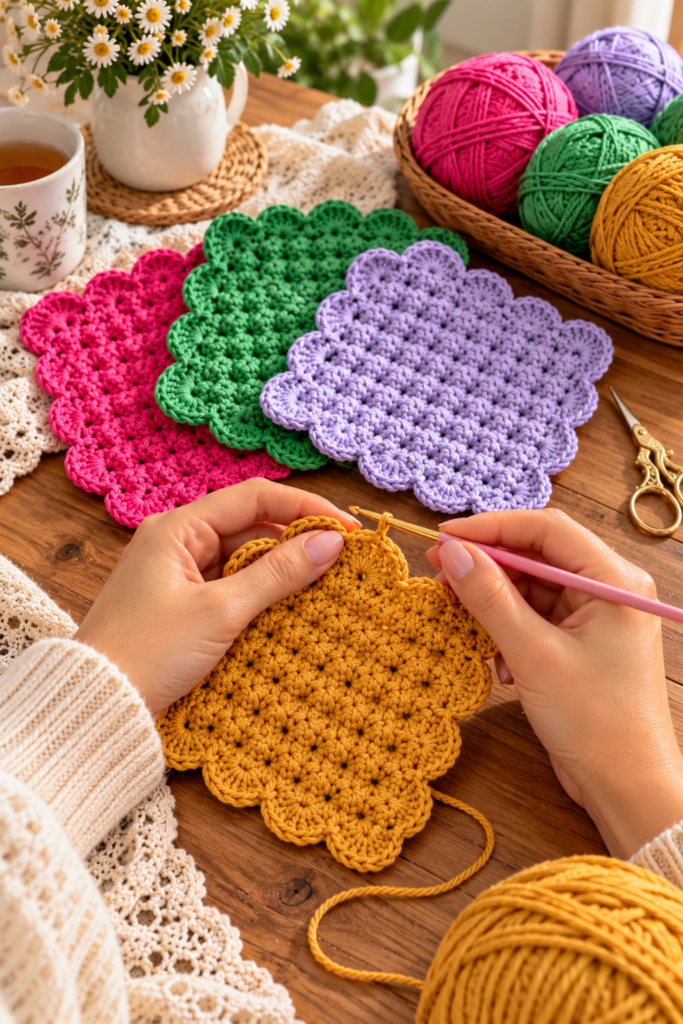
This pattern creates a compact square crochet dishcloth with a richly textured center and decorative scalloped edging.
The construction is very straightforward.
First, you crochet a foundation chain.
Then you alternate between two types of rows:
- A textured row alternating single and treble crochet
- A simple row worked entirely in single crochet
Once you have completed 21 rows, you crochet around the outside of the square to create the border.
That combination gives you plenty of texture without making the pattern difficult to memorize.
Pattern at a Glance
Project: Crochet dishcloth
Skill Level: Easy
Finished Size: Approximately 7 × 7 inches
Hook Size: H / 5.00 mm
Main Techniques: Single crochet, treble crochet, double crochet, slip stitch
Foundation Chain: 22 chains
Total Main Rows: 21
Recommended Yarn: Mercerized cotton
Construction: Worked flat in rows with a border crocheted around the finished square
Why Crochet Dishcloths Are Such Great Projects
If you are learning crochet, dishcloths are one of my favorite small projects to recommend.
You get to practice your stitches without committing to something enormous.
If one stitch is slightly uneven, it isn’t the end of the world. And by the time you finish the square, you have repeated the stitch pattern enough times to feel much more comfortable with it.
Dishcloths are also practical.
Cotton yarn creates a washable fabric that works beautifully for kitchen projects, and the raised texture in this pattern gives the cloth plenty of surface interest.
They are also excellent projects for experimenting with colors.
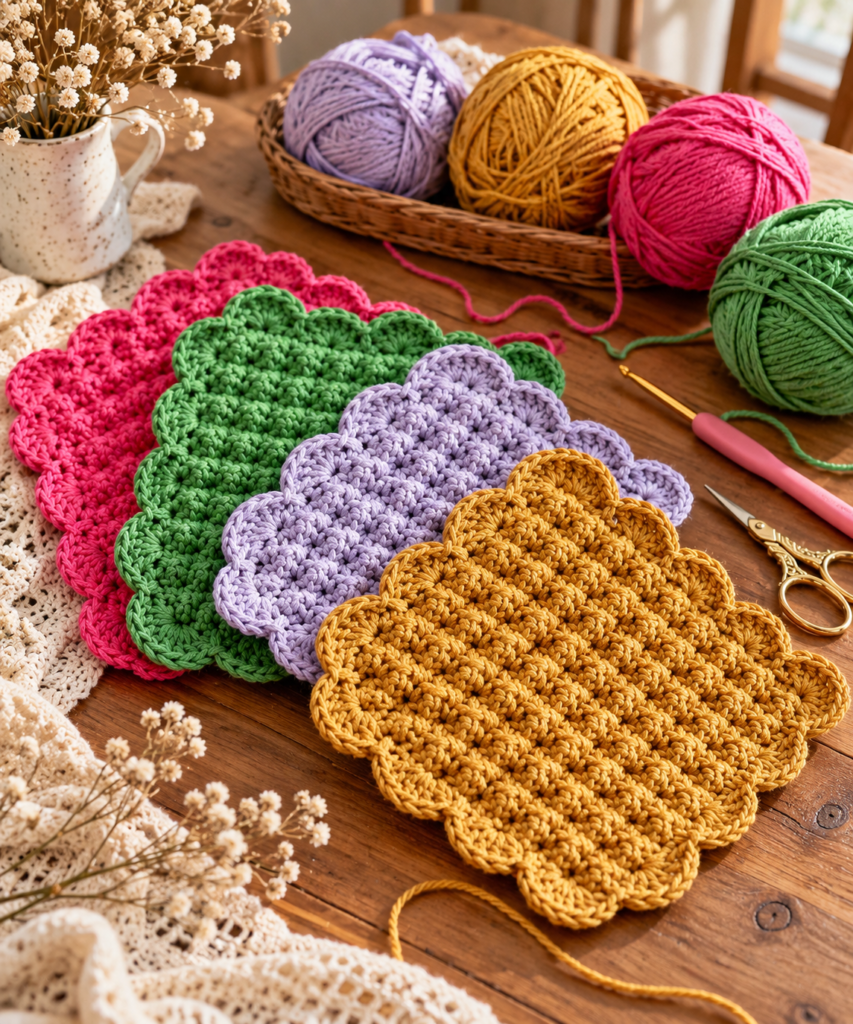
The original pattern shows the dishcloths in several cheerful shades, including green, pink/red, lavender, and golden yellow, demonstrating how different the same simple pattern can look when you change the yarn color.
Materials You’ll Need
The original pattern uses Caron All Day Cotton, a 100% mercerized cotton yarn.
Each skein contains approximately:
100 g / 3.5 oz
and
158 m / 173 yd
The listed colors are:
- Grass Green
- Cherry
- Grape Popsicle
- Golden
The photo on page 1 shows the finished dishcloths worked in these bright coordinating colors, with the raised texture and scalloped edges clearly visible.
Additional Crochet Supplies
You will also need:
- H / 5.00 mm crochet hook
- Tapestry needle
- Scissors
That’s it.
One of the nice things about this project is how little equipment it requires.
Choosing Yarn for a Crochet Dishcloth
For a dishcloth like this, cotton is an excellent choice.
The source pattern specifically uses 100% mercerized cotton, which gives the finished fabric a clean, defined appearance.
If you substitute yarn, choose something that lets you achieve a similar gauge and finished fabric.
Different yarn weights or hook sizes can change the dimensions of your finished square.
For the closest result, try to stay reasonably close to the yarn thickness used in the original pattern.
Crochet Gauge
The pattern gauge is:
15 stitches and 13 rows of pattern = 4 inches
If your goal is to reproduce the approximately 7 × 7-inch finished measurement, checking your gauge is useful.
If your gauge is slightly different, your dishcloth may simply turn out a little larger or smaller.
For a project like a dishcloth, a small size difference usually isn’t disastrous, but gauge becomes more important if you want several matching cloths to be exactly the same dimensions.
Crochet Stitches You’ll Need
This project uses four basic crochet stitches.
Single Crochet – SC
Insert your hook into the stitch.
Yarn over and pull up a loop.
You should have two loops on your hook.
Yarn over again and pull through both loops.
Your single crochet is complete.
Treble Crochet – TC
Yarn over twice.
Insert your hook into the stitch.
Yarn over and pull up a loop.
Yarn over and pull through two loops.
Yarn over and pull through the next two loops.
Yarn over once more and pull through the final two loops.
The treble crochet is complete.
Because the treble crochet is much taller than the neighboring single crochet, alternating these two stitches helps create the pronounced texture in the dishcloth.
Double Crochet – DC
Yarn over.
Insert your hook into the stitch.
Yarn over and pull up a loop.
Yarn over and pull through two loops.
Yarn over again and pull through the remaining two loops.
Double crochet is mainly used to create the decorative border.
Slip Stitch – SL ST
Insert your hook into the stitch.
Yarn over and pull up a loop.
Pull that loop directly through the loop already on your hook.
The slip stitch is used when joining the border at the end.
How the Textured Crochet Pattern Works
Before starting, it helps to understand why such a simple combination of stitches creates so much texture.
One pattern row alternates:
SC, TC, SC, TC…
The next row is worked entirely in single crochet.
Because a treble crochet is considerably taller than a single crochet, alternating the stitch heights creates raised sections across the fabric.
You then return to a simple single-crochet row before repeating the textured sequence.
The result is the dense, dimensional surface visible in the finished dishcloth on page 1 of the PDF.
How to Crochet the Cotton Bloom Dishcloth
Use your 5.00 mm crochet hook and chosen cotton yarn.
Foundation Chain
Chain 22.
Try not to make your starting chain excessively tight.
A tight foundation chain can pull along the bottom edge and prevent your square from lying flat.
Row 1 – Create the Foundation
Begin in the second chain from the hook.
Work:
1 SC in every chain across.
When you reach the end:
Chain 1 and turn.
This gives you the simple foundation for the textured stitch pattern.
Row 2 – Create the Texture
Work:
1 SC in the first stitch.
Then work:
1 TC in the next stitch.
Continue alternating between:
SC, TC
across the entire row.
Your final stitch should be a single crochet.
Chain 1.
Turn.
This is the row responsible for much of the wonderful raised texture.
Keep an Eye on the Alternation
It can be easy to accidentally work two single crochets or two trebles next to each other when you first begin.
Try saying the sequence quietly as you crochet:
“single, treble, single, treble…”
After a few repeats, the rhythm becomes much easier.
Row 3 – Single Crochet Row
Work:
1 SC into every stitch across the row.
Chain 1.
Turn.
This simple row sits between the textured rows and helps establish the repeating pattern.
Continue the Dishcloth
Now repeat:
Rows 2 and 3
until you have completed a total of:
21 rows.
Your final row should be worked entirely in single crochet.
At this point, you should have a textured square measuring approximately 7 × 7 inches when your gauge matches the pattern.
Don’t fasten off yet.
We still need to add the border.
How to Crochet the Scalloped Border
The border is what gives this simple square such a pretty finished appearance.
After completing the final SC of the last row, turn your work.
Begin working down the side of the square.
The border follows a simple repeating sequence:
1 SC in the first space.
Skip 1 space.
Work 5 DC into the next space.
Skip 1 space.
Then repeat this sequence around the square.
Those groups of five double crochets create the rounded scallops.
The original border instructions specify repeating this sequence around the entire square; you may need to skip an additional space near the end to line the pattern up neatly with the starting corner. PAT-DFC-00015-M
Joining the Border
Continue working around all four sides.
When you return to your starting corner:
Slip stitch into the starting stitch.
Tie off.
The border is complete.
Finish Your Crochet Dishcloth
Cut your yarn, leaving enough of a tail to weave in securely.
Thread the tail onto your tapestry needle.
Weave it through the surrounding stitches, changing direction at least once so it doesn’t easily pull loose during washing and use.
Repeat with your beginning yarn tail.
Trim the excess.
Gently straighten the scallops with your fingers.
And that’s it!
Your Cotton Bloom Crochet Dishcloth is finished.
Tips for Getting Beautiful Texture
Keep Your Tension Relaxed
Treble crochet stitches are tall.
If you pull them excessively tight, the fabric may become stiff and the textured effect won’t be as pronounced.
Aim for consistent rather than extremely tight tension.
Count Your Stitches
The pattern relies on alternating SC and TC across the textured rows.
Your textured row should begin and end with single crochet.
If that stops happening, check whether you accidentally added or skipped a stitch in an earlier row.
Don’t Forget the Plain SC Rows
The pattern is not simply alternating SC and TC on every row.
One textured row is followed by one row worked entirely in single crochet.
That alternating row structure is important to the finished texture.
Use Cotton Yarn
For a functional kitchen dishcloth, cotton is a practical choice and is also the fiber used in the source pattern.
Make the Border Last
Finish the full 21-row square before beginning the scalloped border.
The border is worked directly around the completed square rather than being made separately.
How to Customize Your Crochet Dishcloth
One of the easiest ways to customize this project is through color.
Make a complete set using four coordinating shades.
You could try soft pastels for spring, warm earthy shades for autumn, or traditional red and green for holiday kitchen decor.
Because the stitch pattern itself has so much texture, even a single solid color looks interesting.
You can also use these little squares as handmade gifts.
Tie several finished dishcloths together with cotton ribbon or twine for a simple kitchen-themed present.
Frequently Asked Questions
Is this crochet dishcloth beginner-friendly?
Yes. The source pattern lists the project at an easy crochet skill level.
You should understand basic crochet stitches, but there is no complicated shaping involved.
How big is the finished dishcloth?
The finished size is approximately:
7 inches × 7 inches.
Your exact dimensions can vary according to yarn, hook, and tension.
What crochet hook do I need?
The pattern calls for an:
H / 5.00 mm crochet hook.
What yarn should I use?
The original uses Caron All Day Cotton, which is 100% mercerized cotton.
The listed colors are Grass Green, Cherry, Grape Popsicle, and Golden.
How many chains do I start with?
Start with:
22 chains.
Then begin Row 1 in the second chain from your hook.
How many rows should I crochet?
Work a total of:
21 rows.
Your final row should be a plain single crochet row. The original pattern confirms the 22-chain foundation, the SC first row, alternating SC/TC second row, plain SC third row, and the repeat through 21 rows. PAT-DFC-00015-M
Why do single and treble crochet create texture?
The two stitches have very different heights.
Alternating a short single crochet with a much taller treble crochet creates dimensional variation in the fabric.
What stitches are used in the border?
The decorative border primarily alternates single crochet with groups of 5 double crochet stitches, skipping spaces between them.
Do I fasten off before making the border?
No.
After working the last single crochet of your final row, turn the piece and begin crocheting down the side to create the border.
What if the border doesn’t line up perfectly at the final corner?
The original instructions specifically note that you may need to skip an extra space at the end to reach the corner neatly.
That’s completely fine.
Can I make several in different colors?
Absolutely.
The original project itself is shown in several colors, and the simple construction makes this a particularly nice pattern for creating coordinating sets.
Final Thoughts
Sometimes the simplest crochet projects are the ones I enjoy making the most.
There are no dozens of pieces waiting to be sewn together here. There is no complicated shaping and no enormous stitch count to keep track of.
You start with 22 chains.
You settle into that relaxing rhythm of single crochet, treble crochet, and simple single-crochet rows.
Slowly, the texture begins appearing beneath your hook.
And then comes my favorite part—the border.
Those little groups of double crochets transform a straightforward square into something much more decorative. Suddenly, you have a cheerful scalloped dishcloth that looks just as pretty folded beside the kitchen sink as it does bundled into a handmade gift.
Make one in Grass Green.
Try another in Cherry.
Add Grape Popsicle and Golden, or choose an entirely different color palette that matches your kitchen.
Once you memorize the two-row repeat, this is exactly the kind of crochet project you can make again and again.
Small, practical, colorful, and handmade—that is sometimes all a crochet project needs to be.
Happy crocheting!